Research Areas
|
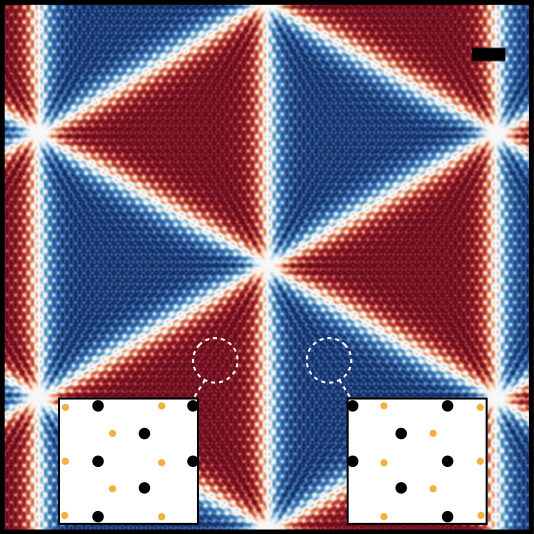
Multi-scale modeling for moiré materialsWe use DFT-based multi-scale modeling to study the properties of moiré materials, such as twisted bilayer and trilayer graphene. Our approach captures key phenomena including structural domain formations, flat bands, and moiré phonon modes. By accurately predicting parameters where strong correlations and nontrivial topology emerge, we aim to guide experiments in discovering exotic phases of matter in moiré systems. |
|
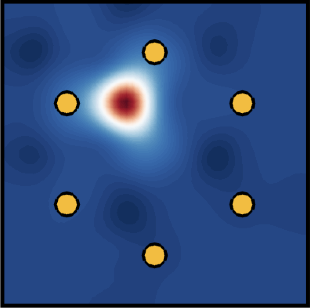
Many-body models for quantum materialsUnderstanding correlated phases of matter, such as superconductivity, requires accounting for strong electron interactions. To bridge theory with experiment, we construct effective lattice models based on parameters derived from our DFT-based multi-scale framework. We then solve these models using unbiased numerical methods, including exact diagonalization (ED), determinant quantum Monte Carlo (DQMC), and machine learning. |
|
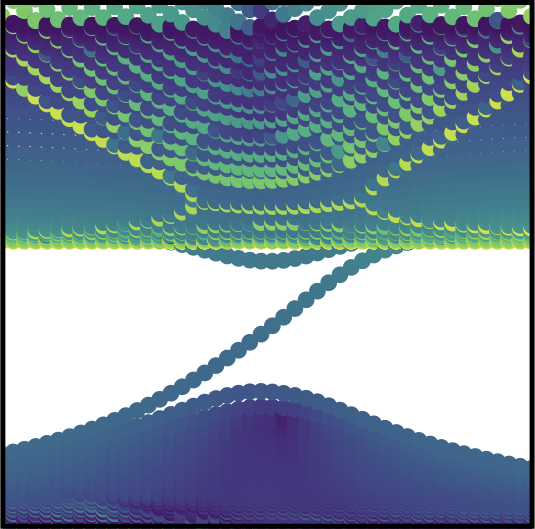
Topological fusionTopology is ubiquitous, shaping phenomena in Earth’s climate, astrophysical systems, and fusion plasmas. We apply numerical techniques to study topological structures in these classical systems. We are conducting an experiment at UCLA’s Large Plasma Device (LAPD) to search for topological waves in magnetized plasmas. |